Definition
A knowledge graph stores information as things and the links between them, so an AI can follow those links to answer questions that need several facts joined together.
Definition
Human-in-the-loop is an AI workflow that pauses at key steps for a person to review or approve the work, so the AI does the busywork while you keep the final say.
Did You Know
A local LLM runs privately on your own hardware with no usage fees, while a cloud LLM runs on a provider's servers and trades privacy and cost for more capable models.
Did You Know
Transcription turns spoken audio into text, while diarization labels which speaker said each part — most interview and meeting tools need both.
Definition
A multimodal AI understands more than just text — it can take in and respond with images, audio, or video too.
Definition
An open-weights AI model is one you can download and run yourself, though unlike true open source, the training data and recipe usually stay private.
Definition
Diarization splits an audio transcript by speaker, labeling who said what instead of leaving it as one unbroken block of text.
Definition
Hallucination is when an AI states something false with full confidence, instead of admitting it doesn't know the answer.
Definition
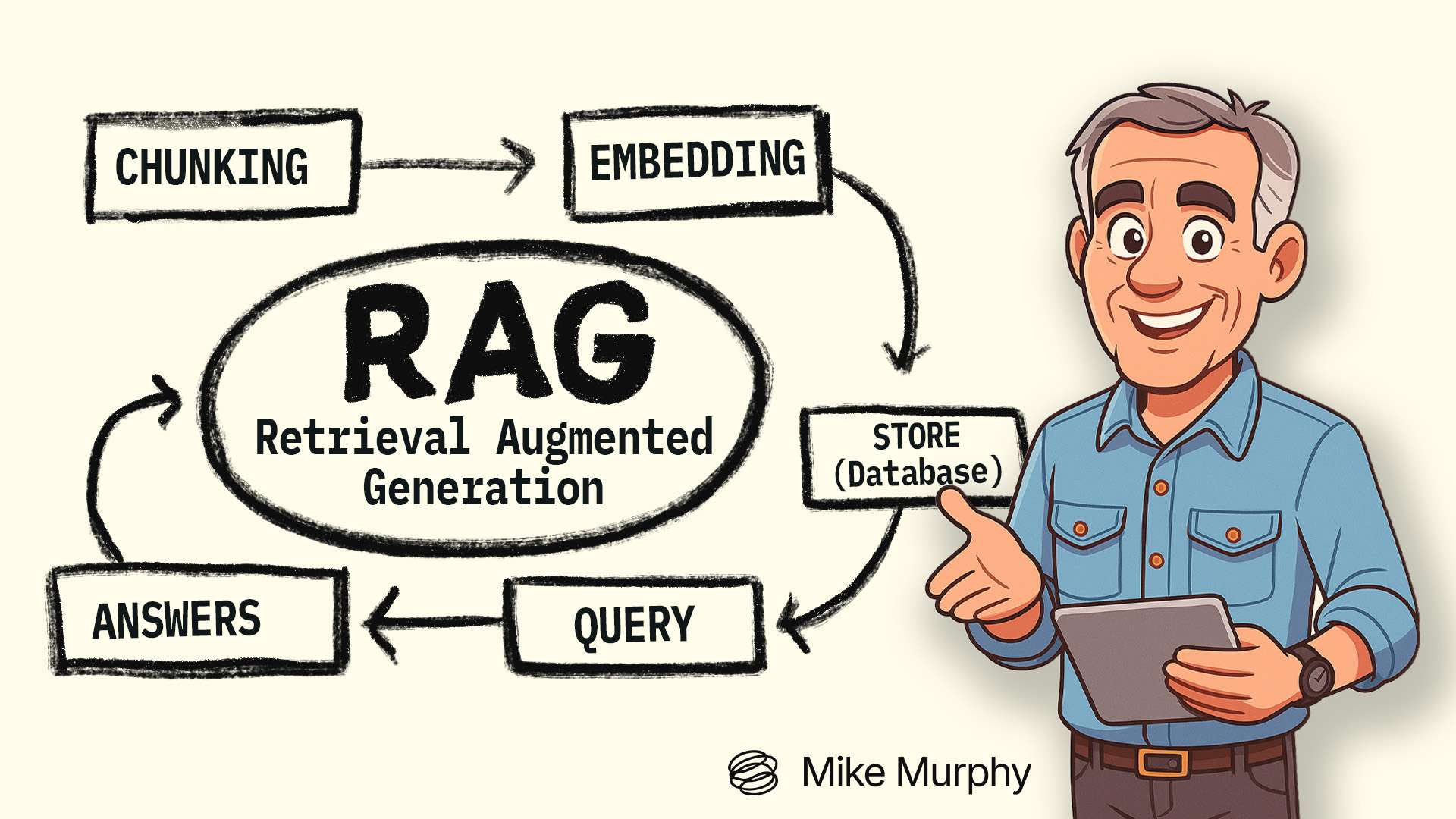
Chunking splits a long document into smaller pieces so an AI system can search and work with just the relevant part instead of the whole thing at once.
Definition
Re-ranking is a second, more careful pass that reorders an initial batch of search results so the best matches end up at the top.
Definition
A vector database stores embeddings so AI applications can retrieve information by meaning and similarity instead of exact keywords.
Definition
Semantic search matches queries by meaning, helping it find relevant content even when the exact keywords are different.
Definition
An AI skill is a reusable, packaged set of instructions an assistant can pull out for a specific kind of task instead of you re-explaining it each time.
Definition
MCP is a standard protocol that lets an AI assistant connect to outside tools and data sources without custom code for each one.
Did You Know
An MCP server exposes tools or data; an MCP client is the AI app, like Claude, that connects to and uses them.
Definition
An embedding is a list of numbers that captures a piece of text's meaning, letting an AI system compare ideas by similarity instead of exact word matches.
Definition
A runtime is the environment actually running your code right now, as opposed to the code just sitting on disk waiting to be run.
Definition
Tool calling lets an LLM request a specific action instead of just generating text, then wait for the result before continuing — it can't run anything itself.
Definition
An AI model is the trained system you load and run to turn an input into an output — an LLM is just one kind, specialized for text.
Definition
An LLM is an AI model trained on huge amounts of text to predict the next word — a simple task that, at scale, produces writing, summarizing, and conversation.
Definition
Context is everything an AI model can see when generating a response — your prompt plus anything else included with it — nothing outside that counts.
Definition
Inference is the moment a trained AI model takes your input and generates a response — as opposed to training, when it originally learned from data.
Definition
The context window is the maximum amount of text an AI model can process at once — go past it, and the oldest content drops out of view.
Definition
A system prompt is the hidden set of instructions that shapes an AI model's role and behavior before a conversation even begins.
Did You Know
A chatbot replies to what you ask; an AI agent can take multi-step action on its own, using tools and checking results, to complete a task rather than just describe it.
Definition
Agentic AI refers to systems where an AI agent plans and takes multi-step actions toward a goal, adjusting as it goes, instead of just responding to one input at a time.
Definition
An AI agent is an LLM given tools and a decision loop, so it can take actions and react to their results instead of just answering a single prompt.
Definition
RAG (Retrieval-Augmented Generation) feeds an LLM relevant external data at query time, so it can answer questions about information it was never trained on.